International Counter Trafficking in Persons Day, 30th July: The Genesis

Since medieval history, human beings still practiced not so good social-cultural lifestyles such as forced marriages, female genital mutilations, debt bondage and slavery; to name but a few. The human behaviour and the socio-cultural practices have over the centuries transformed and changed with the industrial revolution and the modern societal practices as understood today.

Towards the end of the 20th century, slave trade was assumed to be a thing of the past and all civilized societies demonstrated increased degrees of freedoms and adherence to universal declaration on the human rights as guided by the United Nations’ resolutions.

But alas! In mid-1900’s, Human trafficking had started to pick up momentum as a lucrative criminal enterprise whose sole purpose was profiteering. By the year 2000, at Palermo, Italy, the whole world acknowledged that indeed human trafficking had become a thorn on the life humanity and it had exemplified itself as modern-day slavery. The Palermo protocol therefore marked the first major global effort to develop an international instrument that championed a collective effort by UN Member States.

Every country in the world is affected by human trafficking

According to the United Nations Office on Drugs and Crime (UNODC) Human trafficking is a crime that exploits women, children and men for numerous purposes including forced labour and sex. Since 2003 the UN Office on Drugs and Crime (UNODC) has collected information on about 225,000 victims of trafficking detected worldwide. Globally countries are detecting and reporting more victims and are convicting more traffickers. This can be the result of increased capacity to identify victims and/or an increased number of trafficked victims.

In 2006, responding to the Economic and Social Council (ECOSOC) request for intergovernmental agencies to further cooperate in order to strengthen technical assistance provided to countries in the area of human trafficking, the Government of Japan hosted a coordination meeting of international organizations working to counter trafficking in persons. The participating organizations (ILO, IOM, UNICEF, UN Women, UNHCR and UNODC) decided to continue the effort initiated and proposed the creation of a coordination group. The Inter-Agency Coordination Group Against Human Trafficking (ICAT) was formally established in March 2007.

In 2010, the UN General Assembly adopted the Global Plan of Action to Combat Trafficking in Persons, urging Governments worldwide to take coordinated and consistent measures to defeat this scourge. The Plan calls for integrating the fight against human trafficking into the UN’s broader programmes in order to boost development and strengthen security worldwide. One of the crucial provisions in the Plan is the establishment of a UN Voluntary Trust Fund for victims of trafficking, especially women and children.

The Trust Fund facilitates effective, on-the-ground assistance and protection to victims of trafficking, through grants to specialized NGOs. It aims to prioritize victims coming from a context of armed conflict and those identified among large refugee and migration flows.

In 2013, the General Assembly held a high-level meeting to appraise the Global Plan of Action. Member States also adopted resolution A/RES/68/192 and designated July 30 as the World Day against Trafficking in Persons. This resolution declared that such a day was necessary to “raise awareness of the situation of victims of human trafficking and for the promotion and protection of their rights.”

In September 2015, the world adopted the 2030 Sustainable Development Agenda and embraced goals and targets on trafficking in persons. These goals call for an end to trafficking and violence against children; as well as the need for measures against human trafficking, and they strive for the elimination of all forms of violence against and exploitation of women and girls.

Another important development is the UN Summit for Refugees and Migrants, which produced the ground breaking New York Declaration. Of the nineteen commitments adopted by countries in the Declaration, three are dedicated to concrete action against the crimes of human trafficking and migrant smuggling.

Every country in the world is affected by human trafficking, whether as a country of origin, transit, or destination for victims. Traffickers the world over continue to target women and girls. The vast majority of detected victims of trafficking for sexual exploitation and 35 per cent of those trafficked for forced labour are female. Conflict further exacerbates vulnerabilities, with armed groups exploiting civilians and traffickers targeting forcibly displaced people.

Cascading Of The Oversight And Community Feedback Mechanism Trainings At County And Community Levels Report

Background

CHTEA is a member of a technical advisory committee appointed by the minister for Labour to steer a project called, “Fostering Recruitment Agencies’ Ethical Practices and Accountability & Supporting the Government of Kenya to Pilot a Recruitment Oversight Mechanism to prevent trafficking in persons”. This project is funded by IOM and it takes a multi-stakeholder approach that will contribute to the transformation of the recruitment industry in Kenya towards ethical recruitment practices.

The project is expected to support the creation of sustainable business models for recruitment of migrant workers that are consistent with international ethical recruitment standards. It will also address the drivers of human trafficking by enhancing ethical recruitment services on the supply side, while piloting an oversight mechanism with the National Employment Authority (NEA) to monitor and report unscrupulous practices by recruitment agencies.

In order to achieve the purpose of this project, IOM has been running a series of trainings to create awareness at the community level. CHTEA is currently identified as a trainer in this project, (among others organization) to offer skills transfer to a target audience that includes local administration (the chiefs), the Community Health Volunteers (CHVs), the clergy and Community based organizations.  The first such training took place at the Sarova Stanley hotel on April 21st – 22nd 2022

Qatar Migrant Workers Describe ‘Pathetic’ Conditions.

By Stephen Fottrell
BBC News

Image source,
AP Image caption,
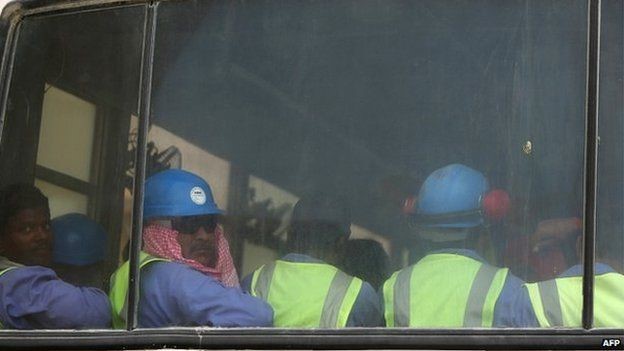
Working and housing conditions of the 1.5 million migrant workers constructing buildings in Qatar ahead of the 2022 World Cup have been heavily criticized.

The Gulf state has made little progress on improving migrant workers' rights, despite promises to do so, according to the rights group Amnesty International. Qatar disputes the claims and says improvements have been made. Here, we speak to three construction workers who have worked on sites in Qatar recently. They describe the conditions there as "pathetic" and "oppressive".

'Frank' (not his real name), 30, from Kenya

"I came to Qatar from Kenya last June to work on the construction sites here.I got the work through an agency. I was paid $350 (£223) a month when I got here, which was a lot less than I was promised. I also spent a lot to get here - over $1,000.

I worked at sites building government schools near [the capital] Doha from June to November last year. There are a lot of infrastructure projects going on here, alongside the World Cup venues”.


Image caption, "Frank" sent this picture of the construction site he worked on near Doha

The main site that I worked on was not a good environment. The majority of the workers are uneducated, and the companies take advantage of them, so they cannot negotiate. They just become helpers and are badly paid. Many just end up accepting it, as they cannot go back to their home countries, because they are supporting their families.

I am sending money back to my family. They are all looking to me, but I can't tell them what it is like here, or they would tell me to come home. When I arrived, I was told that I would be working as an electrician, even though I am not trained, which is dangerous. I got an electric shock on the site once, but thankfully I was OK.

Conditions on the sites are very bad. You work all day out in the open in extreme heat. You start at 04:00 and work all day. There is no cold drinking water on the site, just hot water. It is very oppressive.

Image caption, "Frank" working on a site near Doha, Qatar

No-one will listen if you complain. We once went on strike because we weren't paid for a month. We were eventually paid, but the management didn't care about our complaints. Life in Qatar is very expensive. The accommodation is provided through the company, but food and general living expenses make it hard to save anything. I try to send home what I can.

As for the accommodation, I would describe the conditions as pathetic. In the first place I stayed, Al Khor, there were 10 people to one small room, with five bunk beds and nowhere to put anything. The toilets were outside. It was all very inadequate and uncomfortable. You also have to hand over your passport on arrival, so you can't leave. You feel trapped, like a prisoner.

Media caption,
Mark Lobel reports: ''Our arrest was dramatic - eight cars drove us off the road'' I am now staying in a place called Industrial - where most of the migrant workers live. The hygiene here is very poor. There are five to a room, which is a bit better, but it is not hygienic. I now work in a mall in sales after being allowed to leave my job at the construction sites. It is a bit better, but still not great. Life is very hard here. I would like to see the lives of migrant workers here change. It's just a sacrifice now. There need to be improvements made to safety, salaries and accommodation."

'John' (not his real name), from Ghana

"I am a truck driver working on the site of a new port project near Doha. I came here from Ghana a year and a half ago. Honestly speaking, we are suffering badly at the hands of our employers, especially in the summer time, as it is now. It is 40-50C here during the day, but there is no air conditioning in our vehicles, and we are breathing sandy air. At times the dust and sand flows in the air like snow.

There is nobody to fight for us. For almost two months now, my company has refused to pay our salaries. Our company is killing us because they don't want to give us the little reward we deserve.

My salary of $550 a month is very low for a driver like me. We have no days off to rest. This not only applies to me - it is the same with every worker at my company.I start at 05:00 and work until 19:00, with two hours of transportation to the site and back each day.

Image source, AFP Image caption, There are an estimated 1.5 million migrant workers currently in Qatar

Qatar has a labour office, but if you report your company, they will definitely send you back to your country. So everyone is too scared to report any problems. I'm an orphan from a poor home. I couldn't finish my secondary school education. I have been living in cabins in camps, separated by plywood. Almost all of the workers staying in these camps, are poor and come from countries in Africa and Asia, like Nepal, India, Bangladesh and Sri Lanka. We all experience the same problems.

About 15-20% of the workers here have achieved some quality of living standard, with a good salary, due to their educational background, or they have been able to get work through good foreign companies. But for the rest of us, the payment of salaries is a real headache. How I wish I could save enough money to leave here to get to Europe or the US.

That's my ambition, because in Ghana, even graduates don't have work, so imagine how hard it is for people like me who had to drop out of school."

Stephen Ellis, from Widnes, UK, worked on a World Cup site in Doha in March

"I worked on one of the World Cup sites in Doha at the end of March. I left after two weeks, because the conditions were an absolute disgrace. I work as a pipe fitter and supervisor and have been on construction sites all over the world. These were the worst conditions I've ever seen on any site. Most of the workers at the site where I worked were Indian. They are treated very badly, and the conditions in which they live and work are terrible.

Image source, AP Image caption, The Qatar Foundation stadium in Doha is one of the venues for the 2022 tournament

There is no drinking water available, there is no air conditioning in their cabins - and this was in 45C heat. They have filthy sanitation, and the food is dished out like in the Oliver Twist movie. However, what's even worse is the on-site safety, or lack of it. It does not exist, and my friends and I, who went to work there together, were horrified at the risks taken every day on the site.

We were told that before we started there, one Indian worker had been killed.

The site was run totally by Indians, and they were treating their own people very, very badly. But the upper management did not seem to care. They were just turning a blind to it all. We were told by English managers that if we didn't like it to leave, so we did. There were also other Brits, along with myself, who were treated just as badly.

We were paid a lot more than the Indian workers - they were on about $50 a week, and we were on closer to $33 an hour - but we were still ripped off because we left early."


‘Lest We Forget’: Commemorating The International Day of Remembrance of the Victims of Slavery and the Transatlantic Slave Trade

Introduction

As the global counter trafficking in persons’ institutions ready themselves for the commemoration of their efforts on 30th July, it would be refreshing to be reminded of our own human history that informed this criminal practice. It is our hope and desire that we shall continue to pull together and deal with both the pull and push factors which seem to sustain the criminal endevours of perpetrators.

A historical perspective

25th of Mach 2022 was set aside by The United Nations Educational, Scientific and Cultural Organization (UNESCO) as the International Day of Remembrance of the Victims of Slavery and the Transatlantic Slave Trade. The objective of this day is to enlighten the general public about the tragedy of the slave trade and to engrave the tragedy of the slave trade in the memory of all peoples; The day is viewed as an opportunity to reflect on those that suffered and perished at the hands of slavery, but also as an occasion to raise awareness to the world’s youth about the dangers of racism and prejudice.

The Genesis of Transatlantic Trade

In 1441, Prince Harry of Portugal sent Gonçalves, his captain to the coast of West Africa to bring back a cargo of seal skins and oils. The captain was inexperienced and hence was only sent to bring mundane things. However, he was ambitious; as the ship approached the coast of Mauritania in West Africa, Gonçalves decided to impress the prince by taking back what he knew was his true desire-Slaves. He expected that the prince would reward him highly. And so on his way back, Gonçalves together with his men loaded the caravel with the captives as well as the skins and oils they had been sent to gather, and sailed back to Portugal.

This episode marked the beginnings of an era of European exploration that brought the continents of Europe and Africa into contact with one another through forced transatlantic migrations from Africa to Europe, and eventually to the Caribbean and North and South America. In the 1440s, Gonçalves and other Portuguese explorers began a process that created an Atlantic world connected in ways that it had never been before. This traversing of trade routes and the introduction of African slaves into a new world shaped the lives and experiences of millions of Africans, Europeans, and Native Americans who met on the shores of America. The trade lasted up until 1807 and majority of the captives were collected from West and Central Africa

Remembering the Victims of Slavery

The victims of the transatlantic slave trade endured a series of catastrophic events; they were separated from home, family and nearly all things familiar; captured in the African interior, transported to the coast; sold to slave traders; passed the sea in conditions of squalor and indescribable horror (it is estimated that, out of the 12.5 million enslaved Africans, 1.8 million died during their voyage). The enslavement tested the spirit and will of men, women and children who struggled to find meaning and happiness in a new world order.

Behind the facts and figures are millions of human stories. The stories of those who were ripped from their homelands and families. The stories of those who fought against their oppressors. The stories of those who triumphed against all odds to win their freedom. Those stories continue today as people across the globe keep struggling together against the transatlantic slave trade’s most enduring legacy – racism.

It has always been presumed that the West has been economical with the truth as to the fact that their economies were largely constructed by the sweat, tears and blood of slavery captives. And as the world continues, year in, year out to commemorate the International Day of Remembrance of the Victims of Slavery and the Transatlantic Slave Trade, all efforts need to endevour towards collaboration and to renew the collective resolve to tackle modern day slavery. This year’s theme was, “Stories of Courage: Resistance to Slavery & Unity Against Racism”.

References

United Nations. (2022, March 25). Outreach Programme on the Transatlantic Slave Trade and Slavery. Retrieved from United Nations: https://www.un.org/en/rememberslavery/observance/2022

Williams, H. A. (2014). American Slavery; A Very Short Introduction. New York: Oxford University Press.


Report On The Santa Marta Group Global Conference

Venue: The Pontifical Academy for Social Sciences, Rome (Vatican City State), Italy
Date: 17th – 19th May 2022
Prepared by: Mutuku Nguli, Vice Chair, SMG-A

Pope Francis speaks to those attending an international conference of the Santa Marta Group at the Vatican May 19, 2022. The Santa Marta Group is an alliance of leaders of various law enforcement, government and civic and religious organizations to share their expertise, experience and best practices in the task of preventing and combating human trafficking and modern forms of slavery. (CNS photo/Vatican Media)

Introduction

The Santa Marta Group is an alliance of International police chiefs and bishops from around the world working together with civil society in a process endorsed by Pope Francis, to eradicate human trafficking and modern-day slavery. The Pope describes trafficking as “an open wound on the body of contemporary society”.

The Group is led by His Excellency Cardinal Vincent Nichols, Archbishop of Westminster.

It was named after the Papal residence where the participants from the Vatican Conference stayed in April 2014 and resulted in a signed ‘Declaration of Commitment’ by all the Chiefs of Police present to work together on the International stage to develop strategies in prevention, pastoral care and the re-integration.

The objective of the Group is to combine the resources of the Church with those of Law Enforcement Agencies to prevent trafficking and modern-day slavery, provide pastoral care to victims and assist them with re-integration in the host community for safe return.

Preface

The 2022 Santa Marta Group International Conference took place May 17-19 May at the Pontifical Academy for Social Sciences at the Vatican. The conference brought together a global audience of Cardinals, Bishops, Priests, the Religious, Security experts (police chiefs, investigators, Judicial Officers and Non-Governmental Organizations.

The conference convenor, His Grace, Cardinal Vincent Nichols had initially targeted a large global audience but due to the Covid-19 changing environment, the numbers were reduced to a bare minimum in order to be accommodated at one location inside the Vatican.

In that respect therefore, Santa Marta Group Africa convenor, Fr Mark Odion in consultation with the SMG Director, Dr David Ryall provided for one slot for the SMG-A group. Mr. Francis Mutuku Nguli, the Vice Chair was nominated to present a paper in respect of the work done in Africa. Besides, one Arch-Bishop, a Bishop and two Congregational leaders (Nuns) from Nigeria were also in attendance. Lady Justice Roselyn Naliaka Nambuye from the Court of Appeal in Kenya was also invited to provide an insight on the Rule of Law and Protecting the Vulnerable.

Looking into the future with lessons learnt: The Papal reflection

According to the Holy Father, Pope Francis, since the Santa Marta Group was established in 2014, it has “devoted itself to fostering an ever-greater understanding of the scope and nature of human trafficking and to strengthening cooperation on the international, national and local levels so that effective ways to end this scourge may be found and that its victims may receive needed care, both physically and spiritually,” the pope said.

“Sadly, modern forms of slavery continues to spread,” even in wealthier nations, he said.

The Pope said he hoped the fight against human trafficking would expand its scope and include promoting “the responsible use of technology and social media, as well as the need for a renewed ethical vision of our political, economic and social life, one centered not on profit but on persons.”

The global conference focused on exploring “what works, what doesn’t work and how the Santa Marta Group can make good on its initial promise to bring decision-makers together from around the world to share their experiences and initiatives, learn from each other and find solutions to human trafficking.”

Cardinal Vincent Nichols of Westminster, England and the President of the Santa Marta Group explained that the aim of the conference was “to refocus and re-energize activities in light of a worsening situation across the world caused by the Covid-19 pandemic and continuing conflict and instability in many regions,” he said, and to create an “action plan that will help to guide local and regional activity” and “the way forward for Santa Marta Group over the coming year.” The action plan includes efforts for prevention, education, listening to victims and strengthening collaboration between the church and civil society.

The cardinal said attention must be on healing the wounds of victims and defending their dignity.

During the conference, Fr Mark Odion, Coordinator SMG-Africa Region and Mr. Mutuku Nguli, SMG-Africa Vice Chair presented a paper titled; “A review of the African Church Context in Combating Human Trafficking.” Another African representative from Kenya, Lady Justice Roselyn Nambuye (Court of Appeal) presented a paper on the “Rule of Law and Protecting the Vulnerable.”


Group photo: SMG global conference at the Vatican city, Rome Italy.

Mr. Mutuku Nguli presenting at the conference.

2021 Annual Report

 Introduction:

The year 2021 was majorly a turning point for CHTEA work in East Africa especially due to the new trends in Human Trafficking brought about by the COVID-19 pandemic.  Around the globe, the COVID-19 pandemic has created new risks and challenges to victims and survivors of human trafficking. It has also worsened the vulnerabilities of at-risk groups, especially women and children, to trafficking in human beings. CHTEA focused on strengthening the core fabric of developing a clear cross border framework for the regional civil society. This was mainly achieved through increased partnership and networking, more trainings and workshops, alongside documentation and communication.

Counter human trafficking requires a concerted effort involving both government and non-government stakeholders. On the government front, it was possible to stay engaged with inter-governmental regional efforts such as the East African Community (EAC), the Inter-Governmental Authority on Development (IGAD) and the African Union (AU). At national level, collaboration has been rife with anti-human trafficking secretariats of Kenya, Uganda and Tanzania. While the actual development and implementation of the various new laws remains at different stages for each country. Rwanda, Burundi and South Sudan are still following the pack as they strive to generate appropriate legislation to combat human trafficking; a phenomenon bound to continue getting even more complex, courtesy of the advent of information technology and the effects of Covid-19.

Some of the key highlights for the year:

  • The Karamoja Girls’ Rescue Phase 2:  this was a follow up of a successful rescue operation (by the combined efforts of security agencies from both Kenya and Uganda) which netted 96 Karimojong girls from Uganda. The girls had found their way into Nairobi through an elaborate child trafficking ring of criminals stationed at various locations beginning from Napak district at Karamoja region of Uganda. During the second phase, CHTEA rescued a total of 94 girls (mostly children aged between 8 and 17 years.

The second phase took place between April and June 2021 and it was conducted through a voluntary return process. Those rescued over the 2 months’ period ranged from underage mothers to critically ill girls exhibiting TB conditions and pregnancies, among others. CHTEA provided some temporary shelter spaces at Majengo slums where a total of 125 girls registered. However, the eventual repatriation managed to return a total of 33 victims/survivors and two toddlers. The repatriation and resettlement project was spearheaded by the government of Kenya and the International Organization for Migration who coordinated with counterparts on the Ugandan side. The returnees were given one of the most comprehensive return and reintegration packages.

Victim/Survivor Support Centre (Safe House/Shelter)

Following the successful Karamojong girls’ phase 2 rescue, CHTEA set out a process of obtaining a victim/survivor support center (commonly called Safe house or shelter) which would provide a safe environment for victims’/survivors’ protection and assist in their rehabilitation, return and reintegration. The shelter was inspected by a government multi-agency team consisting the Counter Trafficking in Persons (CTIP) Secretariat and the Directorate of Children’s Services, among others. Once fully operational, it is estimated that the survivors’ support center will be able to host up to approximately 40 persons, with room for expansion if more financial resources become available.

  • Support for Victims of Human Trafficking

During the year, CHTEA material donations worth USD $2000 from the Global Initiative Against Transnational Organized Crime (GI-TOC), an INGO based at Geneva, Switzerland and with regional offices in Nairobi. The donation entailed mattresses, bedsheets, assorted food items, utensils and cutlery, among others.

  • Rescues from the Gulf Countries

Throughout the year, CHTEA was actively involved in the return of survivors of human trafficking from Saudi Arabia, Bahrain, Lebanon and Oman; among other Gulf countries. In two of the instances, a total of five survivors from Saudi Arabia were referred to CHTEA by the Salvation Army Church. The two institutions agreed on a mutual undertaking where the former would meet the survivors at the airport and offer protection and rehabilitation services while the Salvation Army Church compensated all the expenses associated with the services offered. CHTEA organized airport pick-ups and onward services to the survivors until they all got reintegrated to their families.

In one particular case, Alphine (not her real name) was taken to a health facility for medical check-up upon arrival as she exhibited deteriorated health condition requiring surgery. Her treatment has continued well into 2022. She has also been on treatment for severe Post Traumatic Stress Disorder (PTSD). “I am the luckiest person to have survived the brutality of the beastly acts of a slavery-like culture. Your ability to restore my humane feeling is miraculous” Alphine said while leaving Nairobi to meet her children for the first in late December 2021.

  • Policy Influencing

There has been remarkable progress on the part of inclusion to policy influencing platforms. In July 2021, CHTEA was officially commissioned by the Minister for Labor as part of a technical team to spearhead ethical practices of recruitment agencies in Kenya. In effect, this platform has provided the best opportunity yet, to address the deteriorating labor migration challenges in the Gulf region and the diaspora at large. The technical team is gradually but firmly addressing the endemic weaknesses which have been exploited by recruitment agencies so far to reform the sector.

CHTEA also landed a crucial appointment by the Minister for Public Service and Social Protection to be a member of the Advisory Committee (which is the highest policy organ of the CTIP). The advisory committee’s main mandate is to develop and propose to the line-Minister some key frameworks towards an effective implementation and operationalization of the CTIP ACT.

Programming, Regional Networking and Collaboration

  • The annual conference for the Santa Marta Group (SMG), Africa region was conducted once again through online; owing to the continued effects of Covid-19 in 2021. CHTEA is represented at the SMG-Africa Executive Committee level and the CEO serves as the vice Chair of the Catholic led platform which brings together Catholic Bishops and Police Chiefs to discuss about (various) ways of countering human trafficking practices around the globe. The SMG-A conference received presentations from Kenya, Tanzania Uganda, Mozambique, Ethiopia, Nigeria, Central Africa Republic and Egypt; among others. This was followed by a communique which was released to the media at the UK .
  •  During the year, a number of new connections/relationships were established as we continued to strengthen the older ones. CHTEA applied and joined the National Referral Mechanism (NCM) - a National Multi-Agency Coordination platform, hosted and Chaired by the Director General, Department of Immigration. Through this framework, CHTEA was invited to provide an input on the East African Community perspective on counter human trafficking efforts to a Kenya-Government Multi-Agency team.
  •  Again, during the year, CHTEA was approached and continues to work with a regional security organization called the Regional Organized Crime Information Center (ROCIC) based at Khartoum, Sudan. CHTEA is working on providing security intelligence information related to organized crime networks (human trafficking and smuggling) in the region.
  • At the beginning of 2021, the Inter-Governmental Authority on Development (IGAD) ran a civil society/media training at Kampala, Uganda. The Ministry of Foreign Affairs was the lead mobiliser and they in-turn requested CHTEA to provide leadership in the identification of credible institutions to benefit from the opportunity. It was successfully carried out with tremendous success, and the training created a new network of practitioners.
  •   Free the Slaves, a US based INGO convened an online regional conference for Eastern Africa to explore the human trafficking dynamics and provide recommendations on the intervening opportunities for recourse. CHTEA presented a paper on the lessons learnt with respect to victims/survivors of human trafficking.
  • Equality Now, a French based INGO has been running on line and face to face programmes. CHTEA participated and offered resource persons for various sessions during 2021
  •  Within the regional perspective of the CSO network, CHTEA was able to offer a webinar on cross border counter human trafficking (in collaboration with Candle of Hope Foundation, a Muslim NGO working in Kenya and Somaliland)
  • Kantar Public, a global data conglomerate based in the US and with an Africa regional office based in Nairobi, Kenya (works with clients around the world, providing rigorous evidence, insights and advisory services to inspire the next generation of public policy and programs) partnered with CHTEA during a key research project which investigated the experience of Kenyan labor migrants (returnees) from the Gulf Cooperation Council countries (G.C.C.). The project reviewed feedback from Kenyan returnees since 2018. The report will hopefully be released in 2022. The report will be used to inform innovative approaches to help governments and public sector organizations unlock some of the most difficult public policy challenges associated with the human trafficking practices, mobility and migration to build a better, fairer society.
  • On the education front, CHTEA financed the education of over 150 learners from primary, secondary, tertiary colleges and university. Education is one of the most powerful pillars for eradicating poverty which in turn contributes greatly towards human trafficking. By empowering children and youth through an educational program, CHTEA believes that new opportunities for growth and development are availed to this most vulnerable population. Education is not all about white collar jobs but rather, it opens up areas of innovation, jobs’ creation and a fair competition in a liberalized market economy.

Performance in numbers

Table 1: Total number of people reached during workshops in Mukuru Kwa Reuben

Month Male Female Total
January - - -
February 116 142 258
March 186 229 415
April - - -
May - - -
June 141 225 366
July 49 66 115
August 145 189 334
September 336 438 774
October 61 221 282
November 290 461 751
December 83 92 175
TOTAL 1,407 2,063 3,470

Table 2: Total number of people reached during workshops in Mukuru Kwa Njenga

Months No. of Workshops Adults Reached Youth/School Children Total No. of Adults, Youth and Children Reached
January 2021 105 Male               417

Female           933

Male               218

Female           233

                    1,787
February 2021 84 Male               294

Female-          729

Male              108

Female           162

                    1,273
March 2021 95 Male               249

Female           873

Male               135

Female           200

                    1,477
April 2021 96 Male               135

Female           943

Male               129

Female           190

                    1,397
May 2021 97 Male               196

Female        1,165

Male                27

Female             21

                    1,409
June 2021 97 Male               270

Female        1,213

Male                  0

Female               0

                    1,483
July 2021 93 Male               255

Female        1,155

Male                  0

Female               0

                    1,410
August 2021 107 Male               252

Female        1,151

Male               147

Female           180

                    1,730
September 2021 - - - -
October 2021 - - - -
November 2021 90 Male               356

Female           948

Male                 60

Female             76

                    1,674
December 2021 95 Male               455

Female        1,494

Male                 21

Female             19

                    1,989
Total 959 Male           2,879

Female      10,604

Male              845

Female        1,081

                  15,629

Combined summary: No. of people reached

Male                                                                                                                            2,879

Female                                                                                                                        10,604

Sub- Total                                                                                                             13,483

Youth Male                                                                                                                   2,252

Youth Female                                                                                                               3,144

Sub-Total                                                                                                               5,396

Grand Total                                                                                                          18,879

Table 3: Victims’/Survivors’ Report 2021

Adult Children Total number of adults and children
Number of victims identified 129

Male:                20

Female:           109

54

Male:              1

Female:        53

                                 183
Number of victims rescued 71

Male:                  0

Female:             71

54

Male:              1

Female:        53

                                 125
Number of victims referred to shelter 43

Male:                  0

Female:             43

54

Male:              1

Female:        53

                                   97
Number of victims offered medical support 17

Male:                  0

Female:             17

11

Male:              0

Female:        11

                                   28
Number of victims rehabilitated 29

Male:                  0

Female:           29

38

Male:              1

Female:        37

                                   67
Number of victims repatriated and reintegrated 29

Male:                  0

Female:             29

35

Male:              0

Female:        35

                                   64
Number of pre-victims identified 4

Male:                  0

Female:              4

2

Male:              1

Female:          1

                                     6
Number of cases referred to the Directorate of Criminal Investigations 0 3

Male:              1

Female:          2

                                     3
Cross border victims identified 129

Male:                20

Female:          109

54

Male:              1

Female:        53

                                 183

Photo Gallery 


UNODC training: CHTEA participated


Online beaming of a conference from Uganda: CHTEA presented a paper on the Ugandan Karimojong child trafficking situation. The conference was organised by the Ecological Christian Organisation (ECO)

 
Santa Marta Group (SMG)-Africa Conference: CHTEA played a key role in organizing the conference which was beamed from London. Above is the CHTEA team during the online conference (11th and 12th November 2021)

The Annual online conference of the Religious Against Human Trafficking (RAHT). Above team was at the beaming center at the Tangaza University College, Nairobi, Kenya. CHTEA, as a member of RAHT was well represented


Group photo during the training on Child labor, forced labor and human trafficking in Nairobi on CAPSA project by the International Labour Organisation (ILO)


Tanzania: The Mwanza Regional Police holding Dianna Edward Bundala (Emerald King) on ​​a charge of human trafficking and exploitation.

While addressing the media on 26th February 2022 in Buguku Street, Buhongwa Ward, Nyamagana District, the Mwanza Regional Police reported the arrest of Dianna Edward Bundala, 39 years, a resident of Buguku – Buhongwa for the offence of trafficking about 149 human beings.

The victims were reported to have been transported from various places before she locked them up at her home where they lived. Among them were 57 men, 92 women and 24 children (estimated to be aged between 4-17 years). The children were reported to have been removed from various schools. The suspected trafficker is said to have been convincing her subject that she was indeed a god who heals, resurrects people and solves their problems.

Earlier on 23rd February 2022, the police received an order from the Mwanza Mkuyuni Magistrate’s Court seeking for the arrest of one the children’s biological mother, Samir Ally Abbas. In fulfillment of the order, the police visited the home of the suspected trafficker where it was alleged that the mother of the said child was also present.

When the police arrived at the scene, the suspected trafficker led her followers to attack the police and prevent them from carrying out their duty. The police left but returned later and successfully arrested the trafficker as per the magistrate’s order.

The police commenced deeper investigation of the accused and the accomplices in order to prefer appropriate charges, if found culpable. The Police called on citizens to stop using the shadow of religion to deceive and traffic their followers (especially when they have social problems such as diseases and difficult living conditions).


This is a caption of the Mwanza Police boss giving a public statement regarding the arrest of Dianna Bundala ‘Aka’ Mfalme Zumaridi who had camouflaged as a preacher and leader of the Zumaridi church in Mwanza. The wording is in Kiswahili language.


COUNTER HUMAN TRAFFICKING – What fish can do

It was very clear to me that the young woman who came into our office was in great distress.  As we introduced ourselves to each other and Lily began to talk – slowly at first – then most of it flowed out in copious tears.  I realized that the “Beirut Blast” in August, 2020 had taken a terrible toll on her life.  After a painful separation from her husband because of infidelity in July, 2018, she left for ‘greener pastures’ in the Lebanon.  She trusted that her 10 year old daughter would be safe with her mother.

Life was hard in Lebanon and Lily was forced in her own words “to do the work of three people” But she decided not to complain and it was extremely painful when she learned that the first 3 months of her salary was ‘directed’ to her airfare, then from the fourth month she received less than half of what was promised.  At times she felt angry as most days she was on her feet for 18 – 20 hours or more in  back-breaking drudgery.  As the family she worked for gave her no day off she said “I was driven like a slave” (I nodded in agreement).  Some days prior to the blast, Lily felt she could take no more and decided to escape, but life on the streets of Beirut, the capital city was a different kind of nightmare.   She joined some Kenyan women who had an equally checkered history of life in Beirut as homeless African women.  They all slept in one room and took turns that one waited behind to care for the children, while others worked in various casual jobs during the day.

One night when all the women went out as ‘ladies of the night’ while all the children were sleeping, Lily was dragged out by a group of young men who kicked in the door and she was savagely raped by the gang.  She said “I went in and out of consciousness” At that point I was not surprised that she had terrible dreams and nightmares.  With the help of a skilled Psychiatrist, cum PhD in Clinical Psychology, she healed eventually.  But these terrible memories of her experience remain part of her life story.   After the blast, people of various nations received some form of assistance from their embassies but Kenyans did not.  So they got together and decided to storm their embassy – at least 129 of them received tickets to return home.

A New Chapter in her Life

Thankfully, Lily was among those repatriated and came to our office three weeks later.  To add to all the woes in her life at that moment, she suspected that she might be pregnant.  If I could come with her to the hospital she agreed to go and find out the truth.  She shed many tears when the result read Positive, but she bravely told herself and me “it’s not the fault of this baby”.  Now more than ever Lily needed all our support.  As with most victims/survivors of trafficking, she had multiple needs to help to heal and restore her back to life.

Together with her medical care, counseling, housing and livelihood, we felt happy that since she had experience in selling fried fish at the market, we felt confident with her that it would be a good choice to sustain her both in the long and short term no matter where she set up house in Kenya.  But in the current sharp downturn in the economic situation, her sales were slow and the fish proved a disaster!!  Reason? She became inconsolable being forced one evening to throw her precious commodity to stray dogs.  Next day she requested to come to our office, she had spotted a small secondhand freezer for Euro 100.00 (twelve and a half thousand KHS) in the market – however she was halting in her enthusiasm and said “but, Sr Mary, you have done so much for me” I did not hesitate for a moment and suggested we purchase it and have a man pulling a cart (mkokoteni) to take it to her home.  From that time her project has gone from strength to strength.  On a good day her income can be Euro 25.00 or just Euro 6.00, if customers are few. She has been able to take her first born girl to high school using the same business income.

“My Beautiful Lebanese Daughter”

In June, 2021, Lily gave birth to a Baby girl, she called me to say “I have a beautiful Lebanese daughter” Only a woman of extraordinary courage and a heart full of forgiveness could make such a statement.  Of the months of counseling she said:  “only for this gift of counseling and the means of livelihood, I could never have coped so well and be where I am today” Her 12 year old firstborn (girl) is now ready to join First Year in secondary school shortly, it will be a good test of her ability to cope with these extra expenses. We wish her well and are here to support her.

The “fairy tale” of Marion, a Ugandan survivor rescued from Garissa

“A call one early morning from my elder sister who worked for a Somali family in Nairobi change my moods for the day as I anticipated to turn around the financial fortunes of my life”, ‘Marion’ a rescued Ugandan survivor recalls to this interviewer. Marion’s sister has worked for the same family since 2019. The family had asked Marion’s sister if she could bring another Ugandan lady to work as a house help for a related family at a far-flung location called Garissa.

Garissa is 367 kilometers north east of Nairobi. “I was quite hopeful that this new opportunity would greatly change the fortunes of my 5 children after I separated from my husband a few years earlier,” Marion continued to recall. She is the last born in a family of 9. Due to cultural and poverty related factors, Marion was married off at a tender age of 16 years and later, the husband married another wife and divorced her. She was forced to become the bread winner of her 5 children.

Due to the aforementioned challenges, Marion was convinced by her sister who was working in Nairobi to look for greener pastures in Kenya. The sister connected her to an employer at Garissa. “My movement costs were to be fully covered by the would-be employer,” Marion narrates. “I crossed the border on foot to avoid detection by border migration or security agents before I boarded a bus to Nairobi,” she concludes.

Upon arrival in Nairobi, Marion was received by her elder sister who briefed her about her would be employer’s location. She had to spend a night with her sister before leaving for Garissa the following day. The journey to Garissa was not without incidents but what stuck on her mind was how after being stopped by police for questioning, her would be employer sorted the matter out within a short time and she proceeded with her journey. This was despite of lack of proper travel documentation.

To conceal the hidden intentions, her would be employer gave Marion a warm reception and she was introduced to the family members. The family to work for consisted of 12 people. On commencement, she was neither allowed to take a rest nor was she given off days. This was besides being denied food and freedom of movement. Marion was not allowed leave the compound of her employer and was threatened with dire consequences if she dared do so.  The employer did not even provide for her basic needs such as sanitary towels. Eventually, Marion fell sick due to fatigue and the mistreatment encountered. Her pleas to be taken to hospital fell on deaf ears. The employer also forced Marion to refund the money that was used to facilitate her travel from Uganda hence, it meant going without salary until the full amount was recovered. The employer also employed the threats of reporting her to the police station since she did not possess legal migration documents. They even went further to threaten her that she would be accused of stealing.

One week into the job, Marion decided to escape from the family to save her life. “I had no idea where I was in Garissa but I woke up one day and schemed how to leave the family” She dashed out of the gated compound in a blink of an eye and vanished into thin air. Marion decided to use the main road as she kept running as fast as her feet could take her while her heart pounded with great fear. After about 5 kilometers of intense running, her body slowed down and she begun walking briskly to fake confidence…..but it was quite easy to notice that she was a stranger from the majority of the population.

The epitome of human indignity

At one point, Marion decided to stop a boda boda (motor bike riders) to ask for direction to the nearest police station. She had decided to take herself to a police station and risk being arrested instead of risking her life at a brutal work environment.  While she was asking for directions, a relative of the employer spotted her and in turn called her employer.

Within a few minutes, the employer arrived with her car. Marion was forced to enter the private car but she refused upon which, all hell broke loose. She was undressed in public after the employer claimed that she was a thief. They searched all her belongings but nothing was found. One of the non-indigenous residents from the area and who happened to be a Community Health Volunteer (CHV) with some previous training on counter human trafficking happened to have been passing by and noticed the commotion. She confronted the employer and insisted that Marion should have been taken to a police station if they were accusing her of theft. After a long confrontation, the employer agreed and Marion was taken to the police station accompanied by the CHV.

Upon arrival at the police station, the police officers first arrested the employer but released her on cash bail and asked to report back the following morning. The CHV was asked to host Marion until the following morning when her case would be determined after recording statements. Before leaving the police station, Marion insisted that she needed to pursue justice due to her employer’s abuse, exploitation, shame and indignity meted out on her.

Elusive Justice

A phone call was immediately made to the Secretariat of the “Religious Against Human Trafficking” (RAHT) in Nairobi to report the matter who in turn informed CHTEA (a member of RAHT). The latter moved swiftly and engaged further with other key stakeholders who facilitated the movement of Marion from Garissa to a shelter in Nairobi.

The employer offered to give Marion 150 USD so as to drop any charges that she was filing against the employer. For confidential reasons (known to CHTEA), Marion accepted the money and dropped the charges against her employer.

Marion has since arrival in Nairobi from Garissa exhibited signs of severe Post Traumatic Stress Disorders (PTSD) and has since been placed under the care of one of the best psycho-social therapy experts in Kenya. The journey towards full rehabilitation and reintegration has just begun.

CHTEA lures Tanzanian child traffickers into the hands of law enforcers

Emmanuel, aged 14 years is a disabled minor from Tanzania who was lured and trafficked from Shinyanga. At his age, he has never been to school. According to his own account, Emmanuel was lured by a lady through his uncle. The alleged lady trafficker was well known to his uncle and she had promised to educate Emmanuel besides offering to give him a good life in Nairobi, Kenya. On arrival at Nairobi, the trafficker deserted Emmanuel at a popular bus terminus called the Machakos bust station. Upon realizing that his would be guardian was not returning after faking that she was going to the washrooms, Emmanuel decided to crawl to a safe ground on a verandah along the nearest street to take some rest from the scorching sun.

It was during this time while Emmanuel was resting at the verandah nearby market that a different lady approached him and tried to find out how she could help him. After listening to the boy’s plight, the lady offered to go with him to her place of abode and provide him with shelter and food. The new stranger also promised to take Emmanuel to school, he little realized that she was part of a complex network of traffickers (both Kenyans and Tanzanians).  These cruel individuals traffick disabled persons (both children and adults) to Kenyan towns for begging purposes. This phenomenon has turned out to be a big industry in Kenya where the general Kenyan public ‘giving spirit’ is considered to be highest in the East African region. This originates from the “Harambee” philosophy which was adopted immediately after Independence as a catalyst for communal projects where the public were asked to give donations for the public good. Many schools and health centers were constructed through communal giving to take care of local projects. Therefore, this was a well calculated move to confuse the young Emmanuel. He gladly accepted the new offer and she took him to her house at Shauri Moyo, a poor neighborhood in Nairobi.

Forced labor – a beggar in Nairobi

After two days of rest, the young Emmanuel was summoned by the same would-be guardian (the woman) and given instructions to move to the city on a daily basis and beg with a target of five thousand shillings (USD $50) a day. This was a condition in order for him to continue being hosted by his new “master”.  Whenever he didn’t manage to hit the target as required by his host, he was assaulted, denied food and psychologically tormented by the alleged host. The exploitation went on until Emmanuel could no longer bear with the demands, hence he contemplated escaping at the earliest possible opportunity.

Early one morning after he was released to head towards his usual beginning street, he decided to take a different direction and headed towards another expansive slum called Mukuru. While loitering there, he was noticed by a community volunteer who happened to have received training from CHTEA. After a screening exercise, the volunteer contacted a CHTEA officer who validated the assessment report and classified Emmanuel as a case of cross border child trafficking.  Emmanuel was immediately removed from the slum and placed at a protection center outside of Nairobi from where the process of court committal documentation was commenced to facilitate repatriation. The court committal process was handled by a Government Children’s Officer.

The child trafficking ring

In a surprise turn of events, on the day that the young Emmanuel was to be taken to the court for committal orders, the CHTEA officer accompanying the Children Officer received a call from an unknown caller who identified himself as a Police Officer based at a police station in Eastern Nairobi. The caller further claimed that he was in the company of another three men who were supposedly relatives of the young Emmanuel. The whole team of four would later turn out to be part of the trafficking ring based in Nairobi. The caller asked the CHTEA officer to hand over Emmanuel to them as one of them claimed to be his uncle who had brought him to Nairobi. The caller further claimed that Emmanuel had got lost while at his custody as he played with other children in Eastlands. The discussion ended up with a fake arrangement for Emmanuel to be handed over at a designated local administrator’s office.

After brief internal consultations, the CHTEA head office swung into action and immediately alerted the Directorate of Criminal Investigations (Child Protection Unit) who dispatched two police officers to accompany the CHTEA Officer to meet the masquerading group. When they arrived at the designated meeting point, all the four men were already there waiting to be handed over the trafficked boy. The two police officers camouflaged themselves and asked that they be refunded for the expenses of the Emmanuel’s upkeep before they could release him. The traffickers further alleged that the young Emmanuel was a nephew to one of them. The alleged police officer turned out to be real and that he was offering protection to the real traffickers.

At the local administrator’s office, the masquerading group was patiently waiting for Emmanuel’s hand over. The police officers claimed that they had spent a lot of money to keep the boy and that they needed a refund. The request was immediately accepted by asking how much the boy’s upkeep had costed. In a flash of a second, the three masqueraders found themselves under arrest alongside their police protector. On a quick search, they were found with loads of coins (signifying that they were the actual exploiters….as most of the beggars receive much of their donations in coins).

The arrest of this group was a major success in dealing with the child trafficking rings spread across the East African region. Two of the suspects have since been arraigned in court and their case is proceeding at the Kenyan high court under the watchful eye of the Kenyan public and the media. The head of the Anti-Human Trafficking and Child Protection Unit (AHTCPU) of the Directorate of Criminal Investigations, Madam Mueni Mutisya has since commended the efforts of CHTEA in enabling the arrest of the traffickers.

From other reliable sources, it was said that the same clique of traffickers had already trafficked four other disabled children from Tanzania. The DCI Officers are keenly investigating to get on the bottom of the story.  Since the traffickers are from another country, this case will likely be handed over to the Transnational Organized Crime Unit (TOCU) to ensure that all those traffickers are handed down lengthy jail sentences of approximately 30 years.

Above left: 3 Tanzanians suspected of child trafficking during arrest.
Above right: Two of the suspects in court